Hexa Sort
- 4.5
- Rating
- 10.00M
- Installs
- Free
- Price

 Analysis by App-foxy
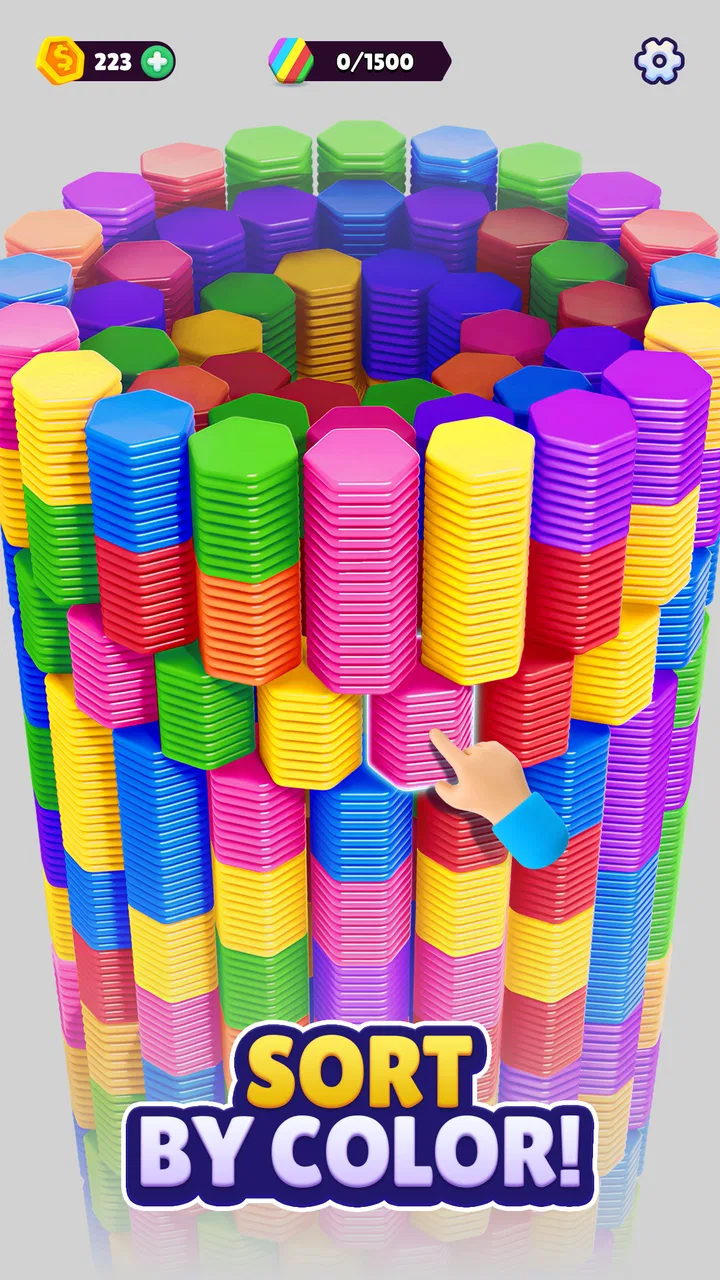
I picked up Hexa Sort expecting a simple color-matching distraction, and that is exactly where its appeal lies. It gives me a board of hexagon tile blocks, asks me to sort matching colors, and turns the arrangement into merges when the pieces meet. The rules are easy to understand almost immediately, but the board still makes me pause before every placement. That combination makes it a strong choice when I want a puzzle I can start without a tutorial and enjoy in short bursts.
This is a free puzzle game from Lion Studios Plus, rated Everyone, and it has already reached over 10 million installs with a 4.6 average from roughly 458 thousand ratings. Those figures match my impression of the game’s audience: it is approachable, visually calm, and designed for people who want a low-pressure mental exercise rather than a complicated strategy system. It is not trying to replace a deep logic game. Its job is to give me a small, satisfying problem whenever I have a spare moment.
Why the first few moves feel so inviting
The opening appeal is immediate because the board communicates almost everything through color and shape. I do not need to memorize a long set of rules or learn a character’s abilities. I look at the available hexagon stacks, identify where a color can fit, and decide whether placing it now will help create a larger merge later. The interaction feels more deliberate than ordinary matching because a careless move can leave the board awkwardly arranged.
You May Also Like

 Blood Strike: 2.5 Anniversary
Blood Strike’s Loadouts Turn Every Drop Into a Tactical Gamble
A close look at Blood Strike’s custom loadouts: how fast access to signature weapons reshapes its battle royale rhythm, rewards preparation, and narrows the gap between fights.

 Pandora - Music & Podcasts
Pandora’s Music Is Easy to Start, but Harder to Recover
Pandora’s strength is its low-effort path from a seed to a station. Its weak spot is how much confidence it asks you to place in connection, setup, and quiet recovery.

 8 Ball Pool
 Is Built on Rivalries, Rematches, and Routine
A close look at the rivalries, rematches, shared routines, and unanswered safety questions that turn a quick pool match into a persistent mobile community.

 Samsung Music
’s Quiet Strength Is Playing What You Already Own
Its reach comes less from spectacle than from dependable access to a personal library. That simplicity is both the app’s strongest retention engine and its ceiling.

 AccuWeather: Weather Radar
AccuWeather Review: A Quick, Clear Forecast for Everyday Decisions
For everyday plans, the best forecast is the one you can understand quickly. AccuWeather makes rain timing, radar, and local conditions easy to act on, with a few trade-offs.

 Hill Climb Racing
Why Hill Climb Racing Still Turns Crashes Into One More Run
A tiny car, a bumpy hill and one more upgrade: Hill Climb Racing keeps resurfacing because its simple chaos makes every near-miss feel personal.
More From Our News Desk



That instant clarity matters in real life. If I have a few minutes before leaving home, I can open the game and begin solving without committing to a campaign, a level narrative, or a long chain of objectives. The first move is usually obvious enough to build confidence, while the following moves gradually introduce the real question: should I take the easy match now, or preserve space for a better arrangement?
The pleasure comes from watching separate pieces become a cleaner structure. A successful merge gives the board a sense of progress without requiring a dramatic reward system. I enjoy the small visual reset after a good decision, especially when one placement creates room for another. It is a modest loop, but it works because the result is visible and understandable.
At the same time, the simplicity has a limit. Players who need a strong story, character collection, competitive ranking, or elaborate objectives may find the first impression too bare. This is a sorting puzzle, not an adventure disguised as one. Its strength is that it gets out of the way; its weakness is that there is less surrounding content to pull me back when the basic placement loop stops feeling fresh.
A rhythm built for interrupted play
My favorite way to play is in short sessions rather than one long sitting. I can make a few thoughtful placements, reach a natural stopping point, and put the phone down. The game does not demand that I remember a complicated plot or maintain a precise sequence of actions across a long session. When I return, the board itself tells me what matters: the open spaces, the colors waiting to connect, and the stacks that need careful positioning.
This makes it suitable for everyday gaps such as waiting for a coffee, taking a short break from work, or sitting on public transport. A realistic session might begin with the intention of making two moves, then continue because a nearly complete color arrangement is tempting to finish. I like that the game can accommodate either choice. It can be a quick mental reset, but it can also stretch into a longer attempt when the board keeps presenting interesting decisions.
The main rhythm is not fast reflexes. I am rarely rushing to tap before a timer expires. Instead, I scan the available pieces, compare the open areas, and consider the order of placement. That slower pace gives the game a relaxing quality, although “relaxing” does not mean every board is effortless. The tension comes from space management and from realizing that an attractive move may make the next several moves harder.
A useful habit is to inspect the whole board before touching anything. I first look for colors that can merge with minimal disruption, then check which spaces might be needed for a less flexible stack. This is more effective than automatically taking the first obvious match. In short sessions, that quick scan also prevents the game from becoming mindless tapping: even a small board can reward a moment of planning.
What happens when I make a poor placement
The game’s most interesting decisions appear when several colors compete for the same useful area. One placement may produce an immediate merge, while another may keep a route open for a larger combination. I do not need advanced puzzle theory to understand this, but I do need to resist the urge to clear whatever looks convenient. The board often rewards patience more than speed.
When I make a bad choice, the frustration is usually mild at first. I can see why the board became crowded, and that makes the mistake feel connected to my decision rather than random. Still, this is where the experience may divide players. If you prefer puzzles with a clear undo button, generous recovery tools, or a guaranteed solution path, the consequences of a cramped board may feel harsher than expected.
I also find that the best move is not always the one that creates the largest visible merge immediately. Sometimes preserving an empty area is more valuable than improving a single color. That is one of the less obvious lessons of the game: space is a resource, not just empty background. Once I started treating open positions as part of the puzzle, the boards became more readable and my decisions became less reactive.
Another practical tip is to avoid mentally locking onto one color. I used to follow the most prominent stack and ignore the rest, only to discover that another color was blocking the placement I really needed. A better approach is to rotate attention between the available colors and the spaces they can realistically occupy. This keeps the board from narrowing into a single tunnel of thought.
Returning after a break
Hexa Sort handles the pause-and-return style well because its central information remains visible. I do not need to reconstruct a storyline or remember a sequence of timed events. I can reopen the current puzzle, spend a few seconds reading the layout, and continue. That quality is especially valuable for people who play with frequent interruptions rather than uninterrupted evening sessions.
For me, the ideal pattern is to stop after a meaningful merge or after creating a clean area on the board. Ending at one of those moments makes the next return easier because I have a clear sense of what I was trying to accomplish. Stopping in the middle of a crowded arrangement is still possible, but it takes a little longer to recover the plan.
The game also works as a mental transition between tasks. After reading messages or finishing a work problem, a brief round gives me something concrete to focus on without demanding the emotional investment of a larger game. That makes it different from many puzzle alternatives that expect me to complete a full level or maintain a streak. Here, the value is in the individual decisions rather than in a long-term narrative commitment.
There is a trade-off, though. Because the game is so easy to resume, it can also become an automatic habit. Opening it for a quick break may turn into repeated rounds if I keep chasing the next satisfying arrangement. That is not a design flaw by itself, but players trying to limit screen time should treat the short-session format as an opportunity for control, not a guarantee of it.
How much replay value the sorting loop offers
The replay value comes from solving a new arrangement with the same basic language of colors, stacks, merges, and available space. I enjoy replaying because the challenge is not only whether I understand the rules; it is whether I can make cleaner decisions this time. A familiar system can still feel different when the order of pieces forces a new plan.
That said, the game’s long-term appeal depends heavily on how much you enjoy refinement. If you need a constant stream of new mechanics, the repeated sorting structure may eventually feel predictable. I would not recommend it as a primary game for someone looking for a deep puzzle system that keeps expanding. Its replay value is more like practicing a compact skill: reading the board faster, avoiding premature merges, and using space with greater discipline.
One of the strongest replay habits is to judge a move by what it enables next, not only by what it completes now. Before placing a stack, I ask whether the resulting position leaves a usable lane for another color. This turns the game from a basic matching exercise into a small planning routine. It is also why the experience remains more engaging than a purely automatic color game, even though the rules stay accessible.
I found that the game is best enjoyed when I set a modest goal for a session. I might focus on keeping the board open, making fewer impulsive placements, or simply completing one satisfying chain. These goals give a round shape without adding unnecessary pressure. They also help reveal whether I genuinely enjoy the puzzle or am only continuing because the next move is available.
Free access and the practical trade-offs
The game is free to download and play, with optional in-app purchases listed from $0.99 to $99.99 per item. That range is worth keeping in mind before installing. The free entry makes it easy to test the core loop without paying upfront, but anyone uncomfortable with optional spending should review their device’s purchase controls before handing the phone to a child or letting someone else play.
The Everyone age rating makes the concept broadly approachable, and the rules are simple enough for casual family play. I would still treat the purchase system as a separate practical consideration from the puzzle itself. A game can be easy for a young player to understand while still requiring sensible account settings around payments. That is basic phone hygiene, but it matters more in a game designed for quick, repeated access.
The current version is 5.2.00, and the listed minimum operating system is Android 7.0. That makes the game accessible to people using older Android devices, at least from a compatibility standpoint. If you are deciding whether it will suit your phone, the operating-system requirement is the first detail to check. The game’s lightweight concept is appealing for an older device, but compatibility still depends on meeting that minimum.
I would not choose this game specifically for a completely distraction-free experience. Short puzzle rounds are its identity, but mobile games can still interrupt concentration through their surrounding presentation or monetization prompts. My recommendation is to try it during the kind of break where a small interruption would not ruin an important task. For a quiet commute or a waiting room, it fits better than during a meeting or while trying to fall asleep.
Who should play it, and who should skip it
I recommend it to players who want a calm color puzzle with almost no learning curve, especially people who prefer making one considered move at a time. It suits casual players, commuters, and anyone who likes arranging objects into a cleaner pattern. It is also a good option for someone who finds traditional match-three games too frantic but still wants a familiar feeling of combining related pieces.
I would suggest looking elsewhere if your priority is a rich story, competitive multiplayer, character progression, or a puzzle game that introduces radically different systems over time. A traditional logic title may be better for players who want fixed, carefully authored challenges. A word game may be a better fit if language is the main source of satisfaction. Even another color-matching game could suit you more if you prefer speed, special effects, or constant chain reactions.
The distinction is important: this is not a game I play for narrative escape. I play it for the small pleasure of turning a messy board into a more organized one. When I am tired, that limited scope is a benefit because I can understand the task immediately. When I want variety, it can become a drawback because the same sorting vocabulary remains at the center of every session.
My casual verdict after using it in short bursts
Hexa Sort succeeds because it respects the appeal of a small, readable puzzle. I can open it, understand the board, make a few choices, and stop without feeling that I abandoned a larger obligation. The hexagon layout gives ordinary color matching a little more spatial character, while the merge loop provides enough feedback to make a good placement feel worthwhile.
Its best quality is interruption tolerance. I do not need a long uninterrupted session to appreciate it, and I can return after a break without rebuilding a complicated mental model. The most useful skill is learning to protect open space and think one move beyond the obvious match. That detail adds genuine depth without turning the game into homework.
Its main weakness is repetition. The same focused loop that makes it accessible may not hold the attention of players who need frequent novelty. Optional purchases are another consideration, particularly for families, although the game’s free price makes trying the core experience straightforward. I also would not mistake its calm presentation for a guarantee that every board will be easy; poor spatial decisions can still create a frustrating position.
Overall, I see it as a dependable casual puzzle rather than a game I would recommend to everyone. If you want immediate pleasure, compact sessions, and a board that can be understood at a glance, it is worth trying. If you want a deep campaign or a constantly changing challenge, choose a more substantial alternative. For my own phone, it earns a place as a short-break game: simple to enter, satisfying when the colors fall into place, and most enjoyable when I play thoughtfully instead of automatically.
FAQs for Hexa Sort
01What is Hexa Sort and how does it work?
Hexa Sort is a puzzle game designed for both Android and iOS platforms. The primary objective is to sort hexagonal tiles by color and pattern to achieve a specific arrangement. Players must strategically move the tiles to solve increasingly complex puzzles, enhancing their problem-solving and critical thinking skills.
02Is Hexa Sort suitable for all ages?
Yes, Hexa Sort is designed to be accessible for players of all ages. The game features a user-friendly interface and offers various difficulty levels, making it appealing to both young players and adults. Parents can rest assured that the content is appropriate for children.
03Does Hexa Sort require an internet connection to play?
Hexa Sort can be played offline, allowing users to enjoy the game without an internet connection. However, certain features, such as leaderboards and updates, may require connectivity. This flexibility makes Hexa Sort a great option for on-the-go entertainment.
04Are there in-app purchases or ads in Hexa Sort?
Hexa Sort offers a free-to-play experience with optional in-app purchases. Players can buy hints or additional features if desired. The game includes ads, but they are strategically placed to minimize disruption. Users can opt for ad-free play through a premium purchase.
05What are the device requirements for Hexa Sort?
For Android, Hexa Sort requires version 5.0 or higher, and for iOS, it requires version 11.0 or later. The game is optimized for both smartphones and tablets, ensuring smooth performance across devices. Sufficient storage space is needed for installation and updates.
Pros
- Intuitive user interface for easy navigation.
- Engaging gameplay with challenging levels.
- Minimal ads
- ensuring smooth user experience.
- Offline mode available for uninterrupted play.
- Regular updates with new features and levels.
Cons
- Limited customization options for gameplay.
- Some levels may feel repetitive over time.
- In-app purchases can be pricey.
- Occasional bugs in older devices.
- Leaderboards lack detailed player stats.

Hexa Sort
Gallery